


13.04.2026 / What will impact truck sales in the coming years?
 Tatyana Arabadzhi, Director at the marketing agency NAPI, discussed the share of Russian and Chinese vehicles in the truck market, sales of "fresh" used trucks, and factors that will hinder new truck sales in the coming years.
In the first quarter of 2026, sales of new and used trucks* decreased by 28.8% and 7.7%, respectively. Trucks manufactured in 2022-2025 accounted for almost a quarter of used truck sales. In terms of the number of "fresh" trucks sold (10.6 thousand units), this segment is only one thousand units behind new trucks (11.6 thousand units). Chinese brands made the largest contribution to the "fresh" used truck segment, accounting for 72% (7.7 thousand units). Trucks manufactured in 2022-2025 accounted for 83.6% of used Chinese truck sales.
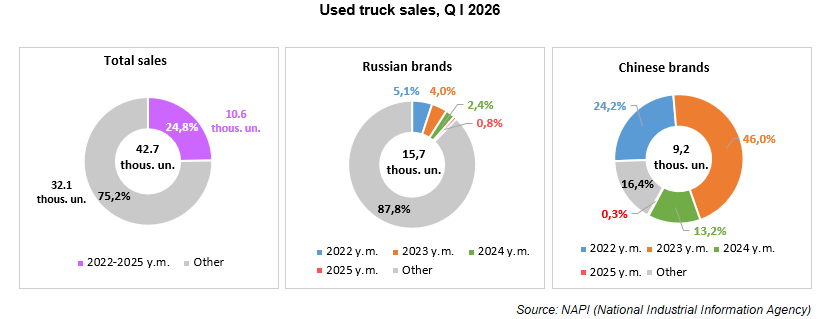
This high share can be partly explained by the significant increase in sales of new Chinese vehicles in the aforementioned years. Subsequently, trucks aged under four years quickly entered the used vehicle market due to economic difficulties: difficulties in paying monthly lease payments, declining freight rates, and a contraction in business in many sectors of the economy.
As for Russian vehicles, they account for 18.2% in "fresh" used truck sales. Analysis of the used Russian truck segment shows that older vehicles are being resold more often, while trucks manufactured in 2022-2025 account for only 12.3%. However, it should be noted that in 2022-2025, sales of new Russian vehicles were significantly lower than those of Chinese ones: 144.9 thousand units against 218.1 thousand units, respectively, meaning Chinese trucks were sold 50.5% more. In the first quarter of 2026, sales of used Chinese trucks of the same years of manufacture exceed those of used Russian trucks by 297%.
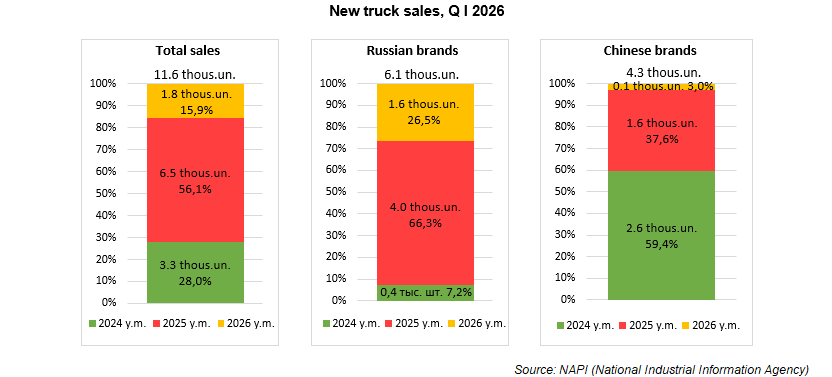
In challenging economic conditions, operation of Russian vehicles becomes more realistic: the price for a new truck is lower, meaning lower monthly lease payments and cheaper service and repair. For example, the average total cost of ownership of the Russian tractor unit is approximately 44 rubles per kilometer for five-year ownership period, excluding leasing costs, while that of the Chinese tractor unit is approximately 47 rubles per kilometer. Moreover, government support is provided for Russian vehicles, so owners are significantly less likely to discard their "fresh" Russian trucks than their more expensive Chinese ones.
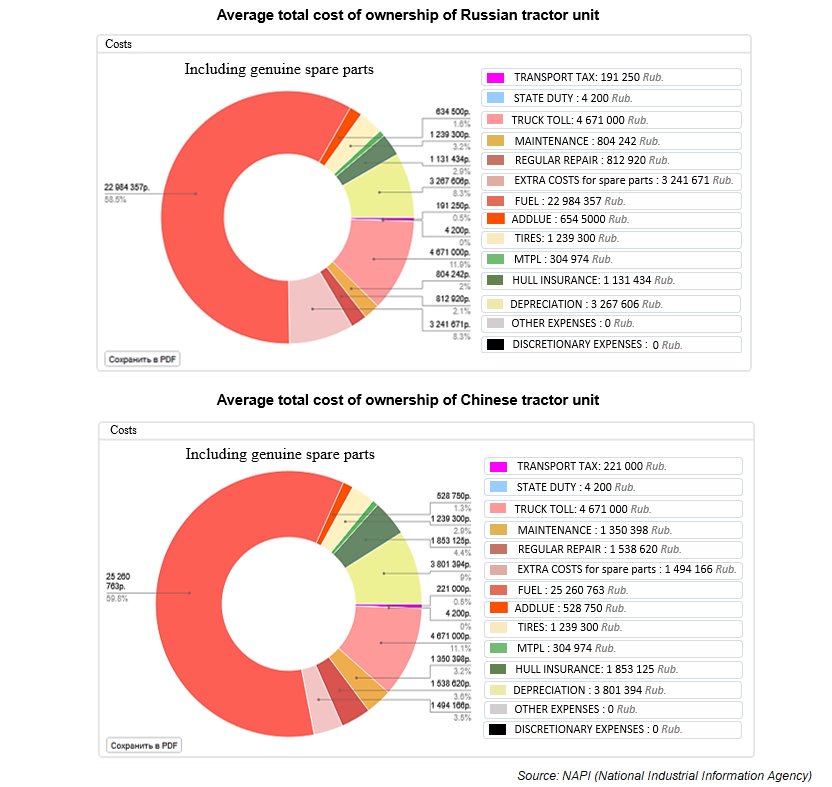
In general, strong new vehicle sales in 2022-2024 and solid 2025 figures will continue to exert pressure on the market in 2026 and 2027. Firstly, early returned and withdrawn "fresh" vehicles offered at significant discounts continue to enter the market. Secondly, companies that purchased new vehicles in the aforementioned years and did not dispose of them will continue to operate them, as updating or expanding their fleets is not economically feasible. Thirdly, dealers have not yet sold out their stocks of new 2024-2025 vehicles. The situation in the first quarter of 2026 is as follows: vehicles manufactured in 2024 accounted for 59.5% of new Chinese truck sales, vehicles manufactured in 2025 accounted for 37.6%, and vehicles manufactured in 2026 accounted for less than 3%. Interestingly, vehicles manufactured in 2024 accounted for only 7.2% of Russian vehicle sales. Russian trucks manufactured in 2025 accounted for 66.3%, while those manufactured in 2026 - for 26.5%.
In the next few years, new vehicle sales will depend not only on the pace of recovery in truck-using industries, government support measures, and implementation of major infrastructure programs, but also on how quickly Chinese vehicles purchased in 2022-2025 will fail and require replacement.
A factor that will significantly slow down new vehicle sales until 2030-2031 could be the acquisition of "fresh" used trucks or new trucks from 2023-2024 stock in 2025-2026, which will be used for 4-5 years before being withdrawn, by a significant number of companies.
* vehicles with GVW over 6 tons

Information
Market analysis
 Spare parts market analysis
 Automotive statistics
 Automotive leasing
 IT-solutions for automotive market analysis
 Taxi population in Russia
 Dealers
 Financial capacity of the automotive market
 Corporate vehicle market
 Total cost of ownership
 Special purpose vehicle
 Legal factors affecting automotive market formation
 Vehicle prices
 Residual value of cars and special purpose vehicles
 Forecasts